
Designed & maintained by Carol Gingell

© C.Gingell 2006-
© Broadland Memories 2006-


 1900-1949 History
1900-1949 Memories
1900-1949 History
1900-1949 Memories
 << Pages 1-10
1900-
The next seven photographs were taken by M.Joy during holidays on the sailing cruisers “Rascal” in 1948 and “Golden Emblem” in 1949 -


The sailing cruiser “Rascal” pictured in 1948. Rascal was one of the Waif class which was available to hire from the Norfolk Broads Yachting Company at Wroxham -
“Golden Emblem” riding out a gale on Horsey Mere in April 1949. One of Ernest Collins fleet at Wroxham, Golden Emblem was a 4 berth, 28ft, sloop-

Another photograph of Golden Emblem taken in April 1949. The mill seen is thought to be Turf Fen on the River Ant (with thanks to Bob Paterson and Thomas Glastonbury).
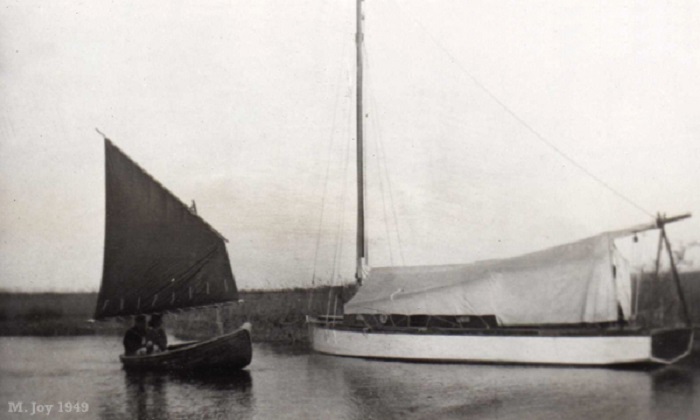
Moored near Hickling in 1949.
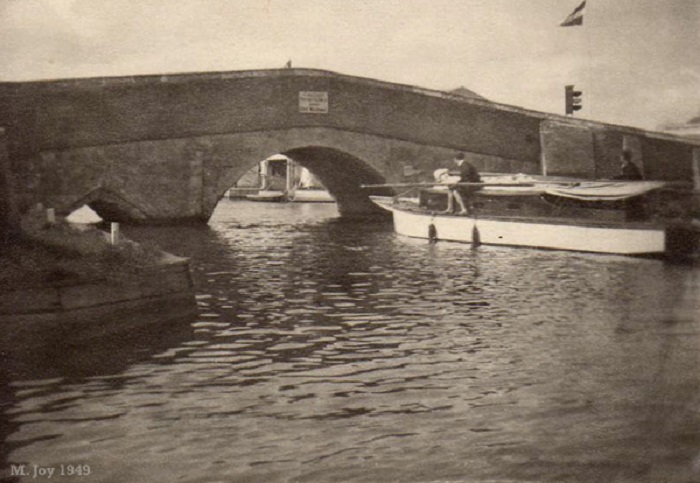
Golden Emblem negotiates Potter Heigham Bridge in April 1949.
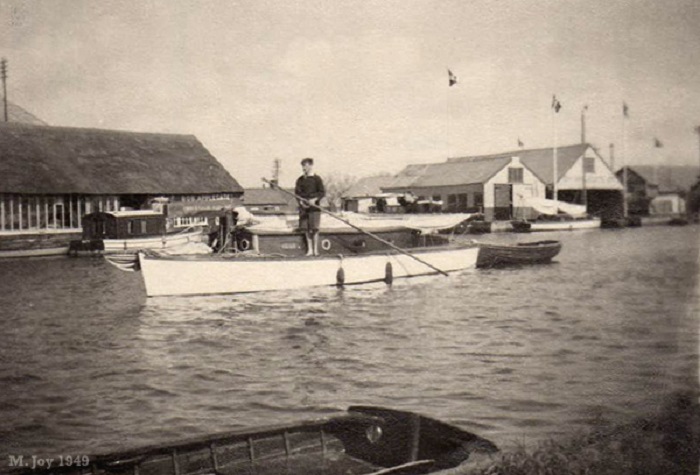
Golden Emblem pictured coming in to moor at Potter Heigham. Bob Applegate’s boatyard can be seen in the background on the left, whilst the boatsheds of George Applegate Jnr. Are seen on the right. George Applegate’s yard was taken over by Herbert Woods after the Second World War, although he continued to use the Applegate’s name.
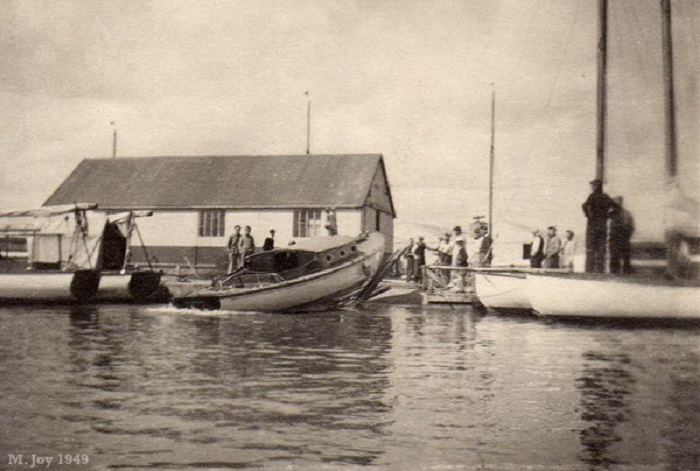
An sailing cruiser is launched at Herbert Woods yard in Potter Heigham in April 1949. ) My thanks to Jamie Campbell for identifying this as the river cruiser which is now called Evening Flight and for providing the following information: “Herbert Woods built her for himself in 1939 and launched her in time for Oulton Week, about ten days before war was declared. He felt Ladybird had been handicapped out of the fleet and put her in his hire fleet, where she remained until around 1972, when Mark Dunham bought her. Many of Ladybird's parts were recycled in the new boat. Her lines were drawn over Ladybird's as "new boat" and was originally drawn with a canoe stern like Ladybird. Keel, rudder, rig and many other parts all found a new home. (the original bunk boards still have Ladybird written in pencil on the underside). The new boat was launched as Mi'Lady but Woods quickly sold her to a man called Simmons who took her to Bourne End for the war. She is considered by some to be Woods' masterpiece -
The following set of images are displayed by courtesy of The Ludham Community Archive Group and feature photographs of H.T. Percival’s boatyard at Horning dating from the 1920s to the 1940s. You will also find some documents relating to Percival’s within the “Boats & Boatyards” section of Paper & Ephemera and a newspaper cutting from the 1970s relating to an etching of Allens yard at Coltishall which was done by Mr Percival’s father c1900.

The first photograph shows the site of H.T. Percival’s boatyard in the 1920s, although at this time it was under the ownership of the Broads Motor Craft Company Ltd. I know nothing about this company, but H’T. Percival bought the land and boatsheds around 1929. According to the author Charles Carrodus in his book “A Norfolk Village in Wartime”, the land had originally been owned by James Lockett who had built a pair of Dutch style tin barns in which to store fodder for the London bus horses, the barns later being used for the villages first motor omnibuses before becoming a boatyard. A reminder of that former owner can be found in the name of the nearby “Locketts” cottage.

he second photograph shows the same scene in the 1930s by which time H.T. Percival was running a small fleet of motor cruisers and yachts. Amongst the motor cruisers were the 33ft 6 berth “Barton”, the 24ft 3 berth “Filby” and the 36ft 6 berth “Ormesby”.
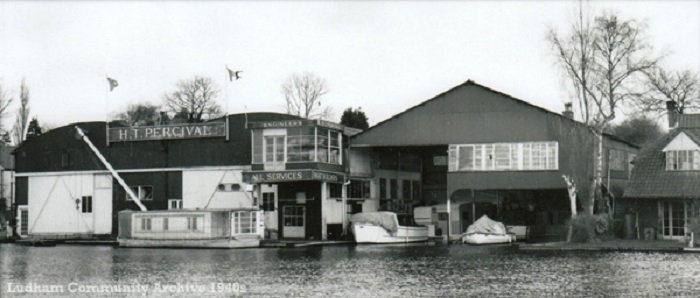
The third photo in the sequence moves on to the late 1940s and shows the yard having expanded with an additional boatshed to the right. During the war, Percival’s had built boats for the admiralty (more of that to follow), but after the war the hire fleet continued to grow. The 1949 edition of Blakes boating brochure shows that Percival’s were running 11 classes of motor cruisers, from the 17ft 2 berth “Peter Pan” up to the 39ft 8 berth “Springtime”. The houseboat seen moored in front of the yard was probably “Summertime” which slept 4 and cost between £9 10 shillings and £12 10 shillings for a weeks hire in 1949.

Going back a few years from the previous photograph, this shows Percival’s yard during the Second World War. With the outbreak of the war the Broads were effectively shut down, the hire industry was suspended and the waterways were declared a no go area for recreational boating. Many of the hire fleets were requisitioned by the admiralty and were towed off to be moored on the open Broads in an effort to prevent enemy sea planes landing. The Broadland boatyards turned their efforts to the building of various military craft for the admiralty and Percival’s were no exception, constructing motor launches for patrol, mine laying and anti-
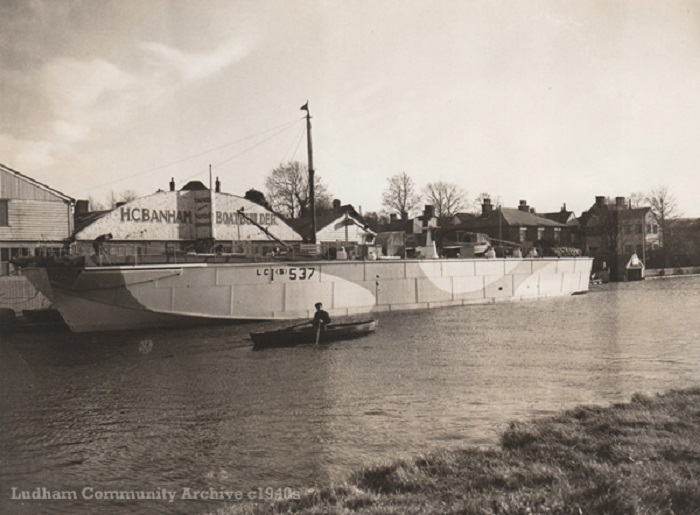
The final photograph shows the same landing craft moored in front of H.C. Banham’s boatyard, a little further upstream at Horning. Banhams were also engaged in the building of military craft during the war, initially constructing 27ft whalers but later working in partnership with Percival’s in the construction and finishing off of the larger landing craft and MTB’s. Charles Carrodus wrote that it was a combined venture which lasted for around three years until the end of 1944 when the production of these enormous vessels was drawing to a close. After the death of Mr Banham in 1960, the yard was sold and became Norfolk Holiday Boats before being bought by the Caister Group in 1966. The land was eventually sold, the boatsheds demolished and housing built.
The following set of photographs were submitted to the archive by Debbie Whymant and belonged to her parents, Brenda and Jeffery Hammond. The photos cover two holidays on the Norfolk Broads which were taken with a group of friends in 1949 and 1950 before the couple married -
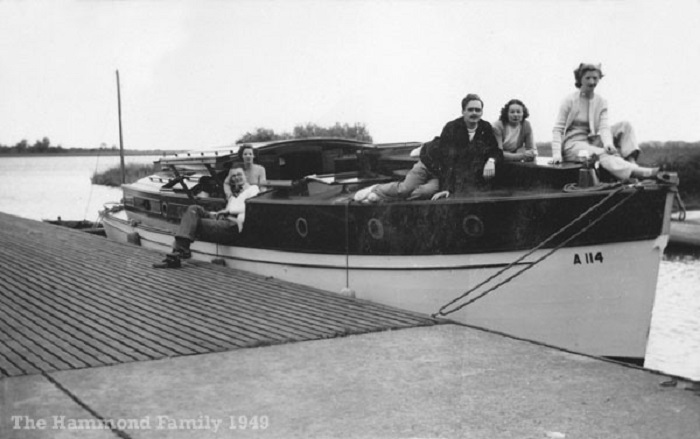
The crew, pictured onboard the motor cruiser A114 “Corinthian” at Hickling in June 1949. It appears that Corinthian and her sister ship “Crusader” were built by Graham Bunn at the Winboats yard at Wroxham c1930/31 and were the original Fair Wind and Good Wind class. These were seemingly sold on very quickly and replaced by the new Fair Wind class in 1933. In 1939 both cruisers were being run as part of J.W. Eastick’s fleet at Acle as Corinthian and Crusader, although where they had been in the intervening years is still a bit of a mystery as they did not appear on Harry Blake’s list. After the war she moved back to Wroxham where she was operated by R.Moore & Sons. By the late 1950s Corinthian was listed as part of W.B.Hoseason’s small fleet at Oulton Broad. As she had disappeared from the brochures by 1960, and her registration number was given to the 1960s built motor cruiser “Master Peter”, it seems as though she was either destroyed or moved away from the Broads c1959. Many thanks to Brian Kermode for his assistance in piecing together the history of Corinthian.

Another photograph of the crew of Corinthian in 1949 -
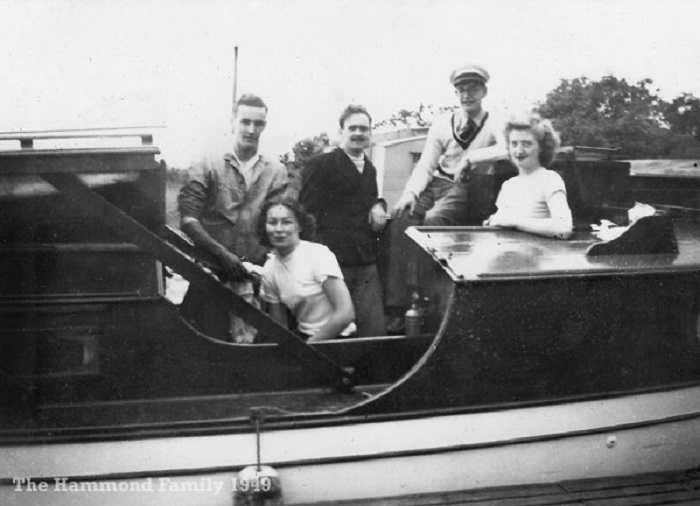
From left to right are: Jeffery Hammond, Ruth Sullivan, Trevor Hall, Don Thompson and Brenda Hammond (nee Lambert).

The motor cruiser Corinthian, labelled as being moored in Acle Dyke. The ships log mentions purchasing supplies from a fishmonger who visited by boat whilst they were here. Corinthian was 35 feet in length and slept up to seven people in three cabins and was quite an elegant looking craft.
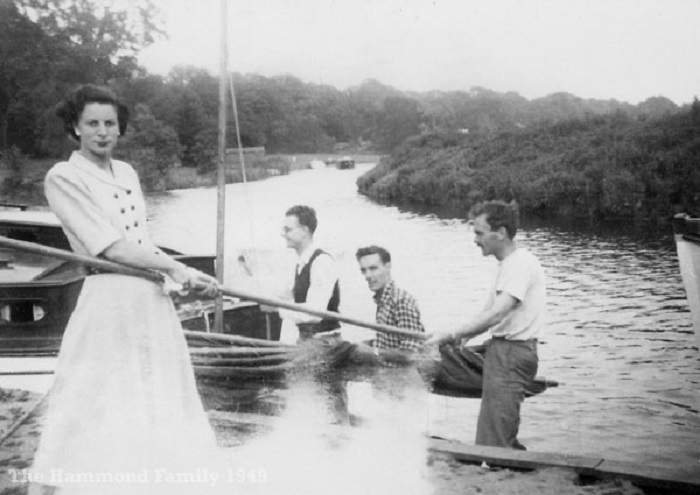
Some of the crew are seen here at the Rising Sun moorings at Coltishall in June 1949.

Another photograph of Corinthian, captioned as having been taken at Stalham in June 1949.
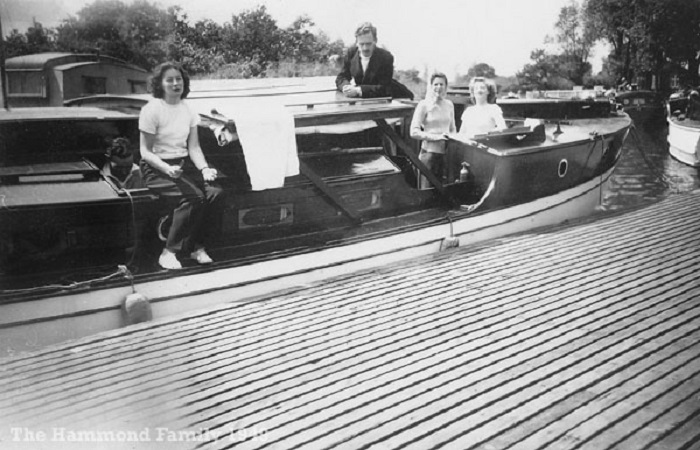
Corinthian and crew moored at the Pleasure Boat Inn, Hickling in June 1949.
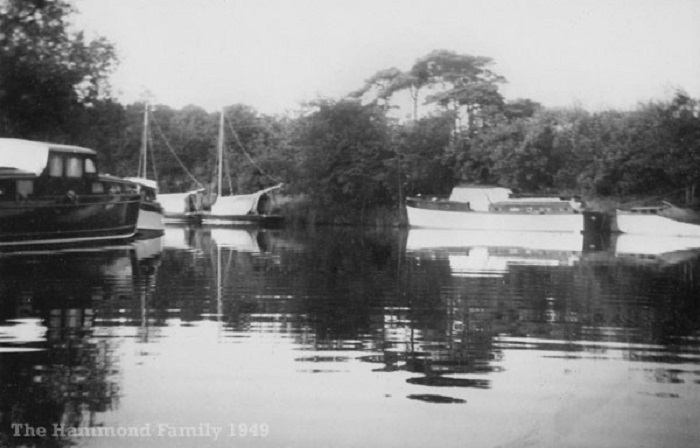
This had the rather confusing caption of “Old Lyme Kiln Dyke (Womack Water)” in the photograph album -
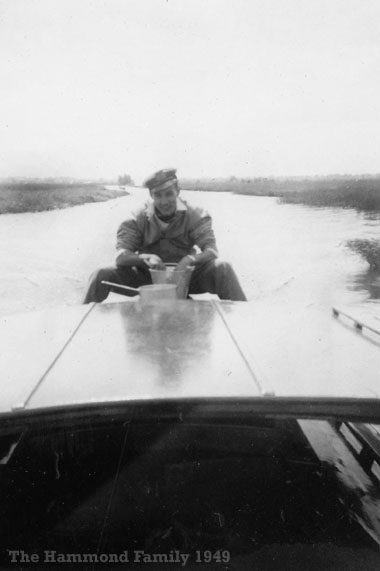

Jeffery Hammond attends to domestic duties onboard the motor cruiser Corinthian in June 1949.
An unidentified sailing cruiser, pictured in June 1949.

In 1950 the gang returned to the Broads and hired one of the “Commander” class of motor cruisers from C.J.Broom and Sons of Brundall. I think the above photograph was actually a promotional postcard produced by Brooms and shows Y167 “Commander I”. The first two examples of this class appeared in the 1947 edition of Blakes boating brochure, with numbers 3 and 4 having been built by the time the 1949 brochure was produced.
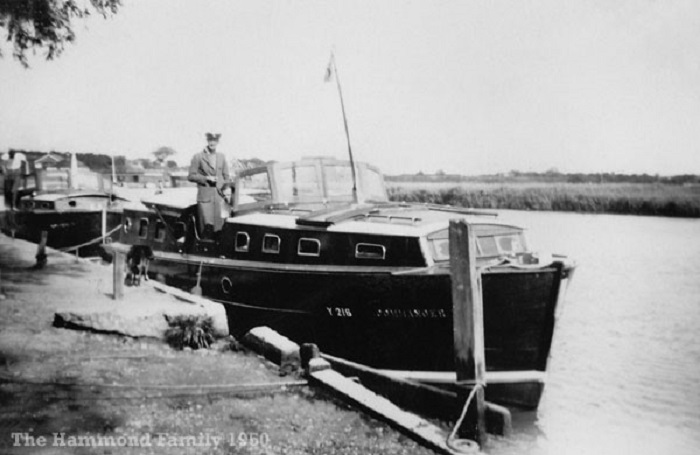
The group of friends hired Y216 “Commander IV” from Brooms in 1950, seen here moored at Reedham. The Commanders were 37ft in length with an 11ft beam and were powered by a 20hp 6cyl Morris Commodore engine, sleeping up to six people in three cabins.

Four of the crew pictured onboard Commander IV in 1950. From left top right are: Don, Ruth, Eric and Brenda.
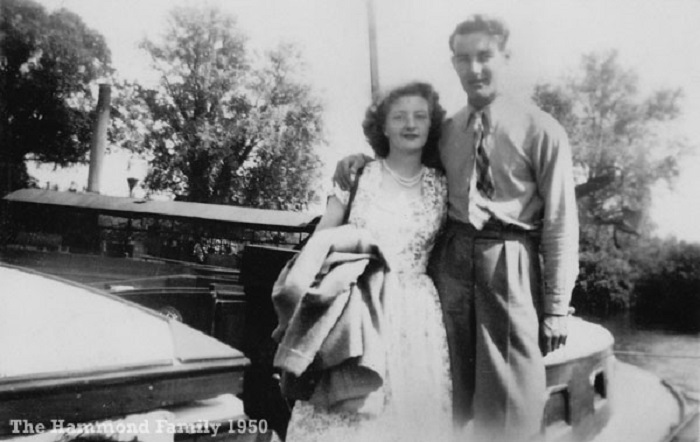
Brenda Lambert and Jeff Hammond pictured on the Norfolk Broads in 1950.
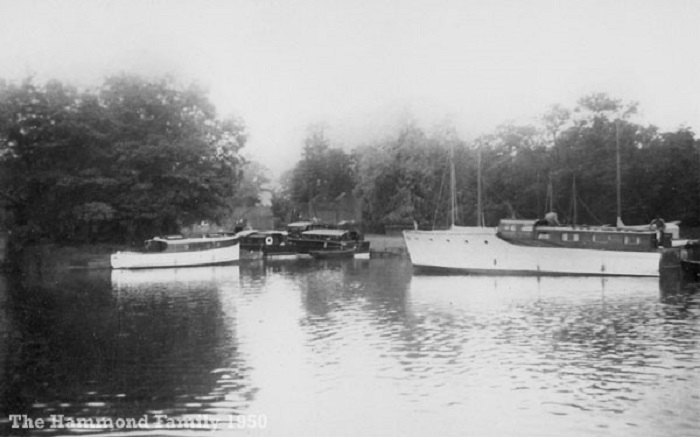
The final photograph from the Hammond family collection was taken at Ranworth in 1950 -