Amongst the galleries of the Broadland Memories website is an extensive collection of images of Broadland taken by local resident Donald Shields between 1903 and 1910. Although an amateur, Donald was an extremely talented photographer who captured some stunning images of Broadland during the Edwardian era. I’ve often wished that I could go back and see what the area really looked like at that time. As the possibility of finding a time machine seems unlikely, I thought I’d use a little photo editing wizardry to try to bring the past to life instead.
Following our second house move of 2020 in October, (and hopefully the last move for the foreseeable future), I finally have my much wished for office space from which to work on Broadland Memories. It certainly beats working from a settee in the living room as I have been for the last 14 years! I am just about there with getting everything set up and will be starting to add new additions to the website very soon. In the meantime, I’ve been experimenting with colourising a few old photographs from the archive whilst getting my hand back in and I thought I’d share some of the results here. It’s amazing how many details you can now pick out.
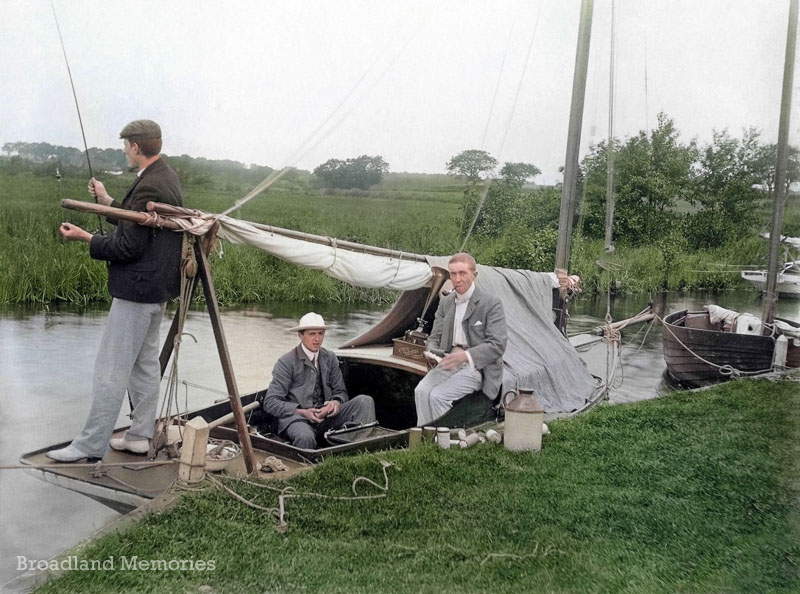
The photograph above is from 1903 and shows three of Donald’s friends at an unknown location on the Broads. Note the phonograph with its horn sitting on the cabin roof. Both of the seated chaps are holding wax cylinders to play on it, with further cylinders seen lined up on the bank beside the boat. The phonograph system of recording music and spoken word on cylinders, to then be played on portable machines, was initially invented by Thomas Edison in 1887, but the use of wax cylinders was introduced by Alexander Graham Bell a few years later with his “Gramophone” system. Not to be outdone, Edison developed a better version of the wax cylinder which then became the industry standard. The earlier cylinder players came with an attachment so that you could actually produce your own recordings too. The machine here appears to be an “Edison Standard Phonograph” which was introduced in 1898. There were no volume controls on these machines, so it’s little wonder that early 20th century guide books urged visitors to keep loud music down at night!
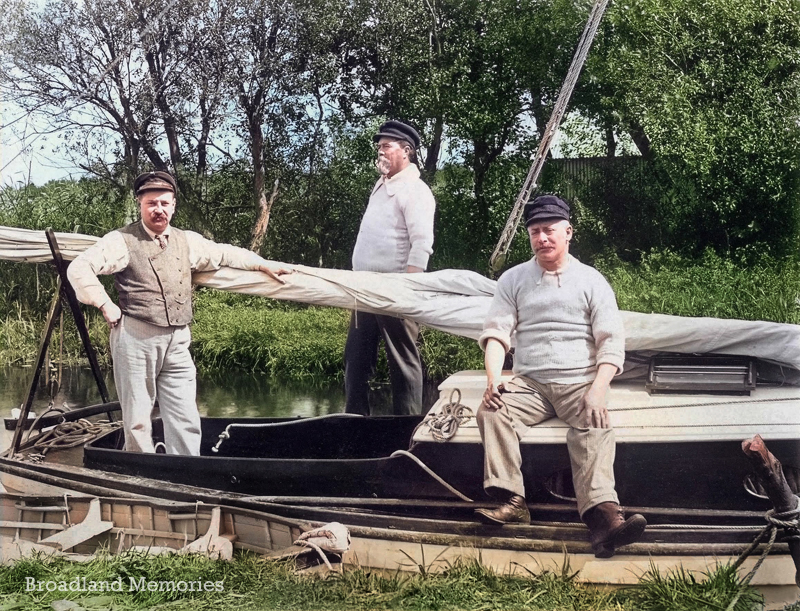
Another shot from 1903 – three unidentified sailors posing on board their sailing cruiser.

Moving on a few years to 1910 when Donald, along with his brothers Charlie and Archie, joined a group of friends aboard the wherry Bertha. Archie is pictured here on the right, holding the dog, whilst Donald is seen with his arms around the shoulders of another two members of the group. The two gentlemen in cricket whites are wearing jumpers with a logo which bears the initials R.A.O.I., and an earlier photograph in the set showed the party holding a large banner emblazoned with this design. I’ve been unable to find out what this stood for. Answers on a postcard please!
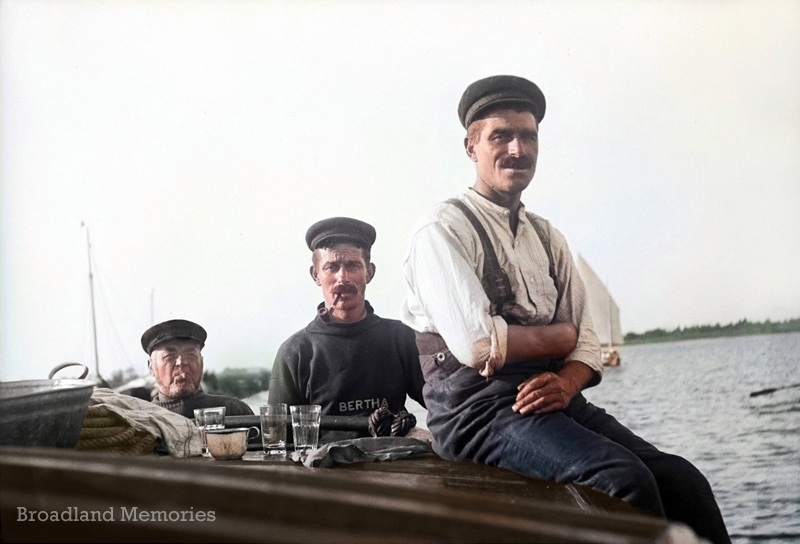
The skipper and mate, along with what appears to be another wherryman on board (left). Bertha was operated at this time by Pallett, Barclay and Co. of Bacton Wood Mill on the North Walsham and Dilham Canal, but had originally been owned by the Press Brothers. Bertha was a converted trading wherry and an advert for the Press Bros. from the 1880s shows that they were offering four other wherries for hire alongside her – Elsie, Kate, Diligent and Lucy. Initially, the wherries would have been converted during the summer months for the short holiday season and would have then reverted to carrying cargo for the rest of the year. As demand for boating holidays aboard wherries increased, and the holiday season was extended, they were permanently converted for pleasure use. By the late 1890s, the company had become Press & Pallett who were listed as being millers, maltsters, cake, corn, coal, seed and manure merchants at Bacton Wood Mill, Staithe and railway station. When Edward Press died in 1906 his property, including the canal, were sold at auction and a Mr Barclay must have bought into the business as by 1912 the company was listed as Pallett, Barclay & Co.
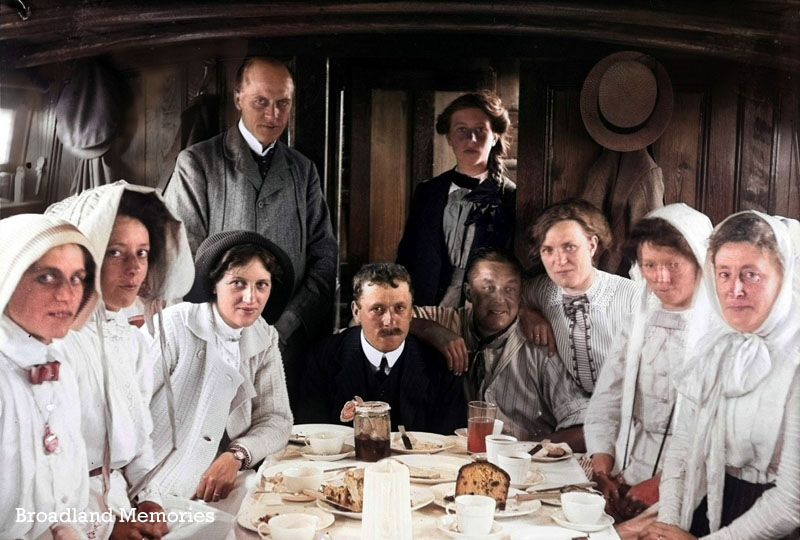
At the beginning of the trip, the party were joined by their wives for afternoon tea on board Bertha. The colourisation has beautifully highlighted the spread on the saloon table – bread and jam and some rather nice looking fruit cake. Whilst most are enjoying a cup of tea, there is one pint of beer in evidence. Although one of the ladies clearly moved whilst the photograph was being taken, this is still such an evocative shot.
You can view the full collection of Donald Shields original photographs here: 1900 to 1949 Photo Gallery Page 10 (broadlandmemories.co.uk)


