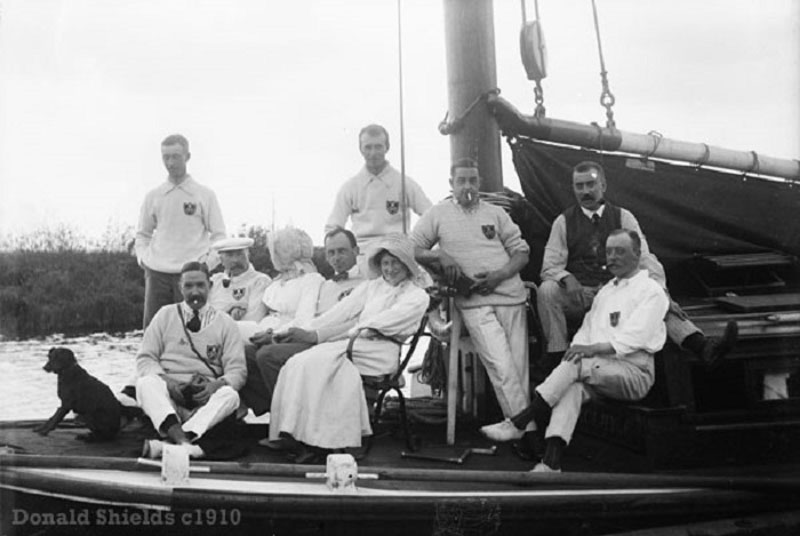
Browse through the collections of Edwardian era photographs of the Norfolk Broads on the Broadland Memories website and you can’t fail to notice how elegant and genteel a boating holiday appeared to be back then. The ladies in their long, flowing dresses and beautiful hats, the gents in their cricket whites, sporting crisply coiffured moustaches, always arriving and departing in their Sunday best suites. Nothing summed up that elegance more than the pleasure wherry, the height of luxury and comfort in boating for those with the means to pay for it.
A quick thumb through the pages of H. Blake & Co.’s 1916 Norfolk Broads Yachting List gives a good indication of the number of pleasure wherries and wherry yachts which were available for charter. Today, a scant few survive, lovingly restored and maintained and in private ownership or under the wing of the Wherry Yacht Charter Charitable Trust. A day trip on one of these magnificent vessels is a wonderful experience, a taste of those halcyon days of Broadland summers in the early 20th century. Blake’s 1916 brochure shows enticing photographs of just some of the pleasure wherries which once sailed on these waterways – Victory, Empress of India, Rose, Surprise, Dauntless, Fairy Queen, Endeavour, Freedom, British Queen, Sunbeam, Reindeer, Chloe, Red Rover and Dragon (pictured below). Add to that the wherry yachts which were also available to charter and it’s an impressive list indeed. There were other boatyards outside of Blake’s agency which advertised wherries available for holiday hire and a number of hotels and other riverside business had a wherry or two available for hire over the years. There were of course those which were built for private owners too like Hathor.
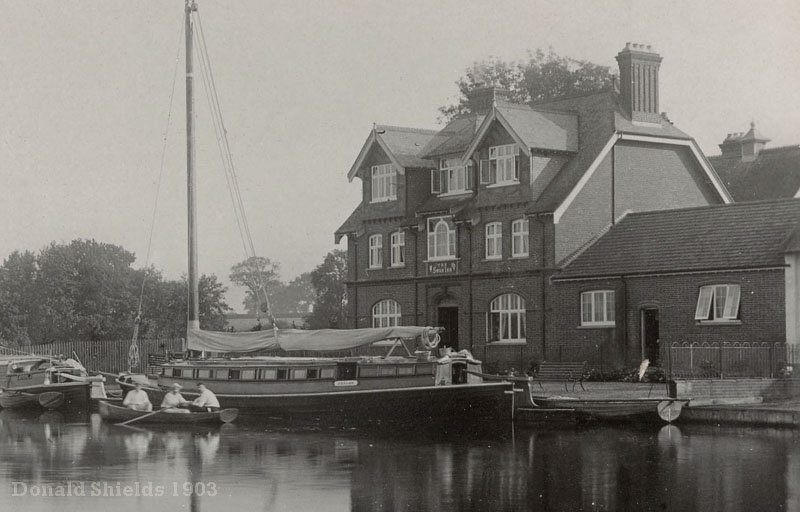
Some were true pleasure wherries, built for the sole purpose of serving the holiday trade, or private owners, but many began life as one of the black-sailed traders, carrying coal, timber and all manner of goods between the ports of Great Yarmouth, Lowestoft and Norwich, and the towns and village staithes of Broadland. A decline in the need for transportation of goods by river began with the coming of the railways in the mid 19th century, but the railways also brought visitors to the region, often by their hundreds on the newly introduced Bank Holiday’s. The well-healed and the professional classes were drawn to the region for longer visits by the rural idyll portrayed in the photographs of John Payne Jennings and Peter Henry Emerson, and the numerous guide books and magazine articles written about the Norfolk Broads in the 1880s and 1890s. Enterprising wherry owners saw that there was need for comfortable, floating accommodation and so the trading wherries were swept out and converted for the use of holidaymakers during the summer months, reverting to carrying cargo during the winter.
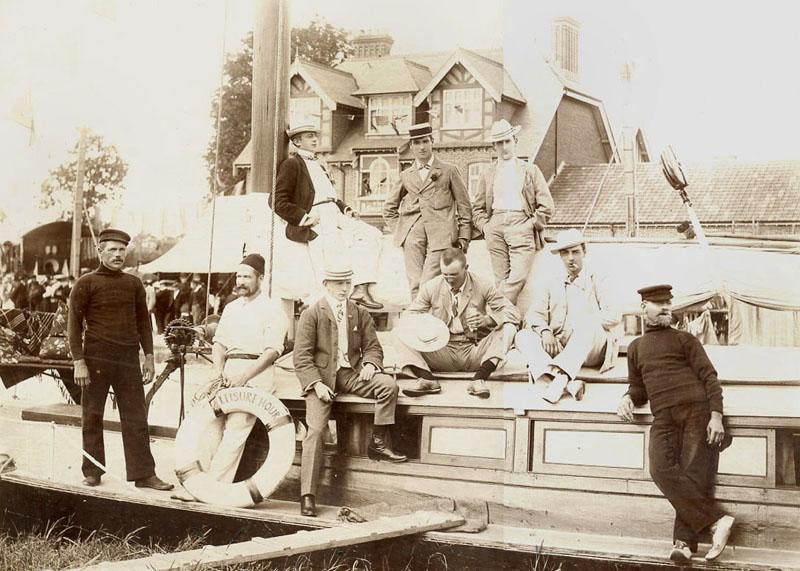 As the 20th century dawned, it became increasingly common for the conversions to be permanent, the growing number of such vessels for hire being joined by the purpose built pleasure wherries and wherry yachts such as Norada and Olive which are both still sailing today.The fate of some of those that are no longer with us is known, many ended their days being used to shore up a stretch of riverbank, were sunk in dykes or just broken up for firewood. Occasionally, if you know where to look, you can catch a glimpse of a tabernacle marking the last resting place of one of these former giants of the waterway. Slowly, those remains are disappearing as the wood rots away and their unmarked graves are becoming just memories.
I made passing mention of the pleasure wherry Arcadia in the last blog post in relation to her starring role in a British Pathe film of 1933 and it reminded me that I have been meaning to write a piece about her for a while. Arcadia was one of those which began life as a trading wherry, and one who’s history was wonderfully detailed by the author Charles Carrodus in Life in a Norfolk Village which was published by The Soman-Wherry Press Ltd. in 1949. With fascinating accounts of life in Horning from the mid 19th century through the first half of the 20th century, it’s a book which deserves a place on the shelves of anyone interested in Broadland’s history and can be sourced for around £25. The wonderful City Bookshop in Norwich usually has copies available and offers a mail order service. Much of he following is gleaned from the Carrodus book and by searching the relevant census returns.
Arcadia was built as a trading wherry by the boat builder Samuel Gibbs at Coldham Hall in 1897. Given the name Forget-Me Not, she was commissioned by Robert Royall who had made his money after emigrating to Canada and she was sailed by his brothers Joseph and Ernest. Forget-Me Not was different to other wherries in that she was apparently built to a keel, rather than having the keel added later as was usual. She was also built to carry heavy cargoes. Samuel Gibbs was listed on the 1891 census as a boat builder living in a cottage in Coldham Hall Road at Surlingham with his wife Mary Ann , sons Charles (aged 18 and a waterman), Samuel (aged 12 and at school) daughter Sarah, aged 6, and grand-daughter Elizabeth aged 10. Four borders were also in residence, 24 year old widow Elizabeth High and her three young children. Earlier census returns show that Elizabeth was actually Samuel’s step-daughter and that Mary Anne was his second wife. Samuel had seven other children with his first wife Elizabeth and the family were recorded as living in Row 27 at Great Yarmouth in 1871. By 1881, Samuel was married to Mary Ann and was building boats with Arthur Reynolds at Coldham Hall according to Whites directory of Norfolk.
 Forget-me Not’s first cargo was collected from Colman’s Wharf in Norwich with Joseph Royall as skipper and younger brother Ernest as mate. Sadly, Joseph drowned in April 1908 as they sailed through Reedham. Walking towards the forepeak, he was apparently swept overboard when she took a nasty gybe and was carried under by the strong tidal flow. His body was never recovered. Forget-Me Not was put up for sale and was bought by a Mr Woods at Beccles who converted her into a pleasure wherry and changed her name to Arcadia. In 1919 she was purchased by Major E.F. Medcalf for £1100 but he apparently used her for only two months and she was then put up for sale again by auction the following spring. She was bought for just £180 by the silent film actress Ivy Duke who renamed her Cara Mia and moved her up to Salhouse Broad where she and future husband Guy Newall were reported to have spent Christmas together onboard in 1920. Re-planking and other restoration work was carried out by a member of the Press family at a cost of £500 and Ivy and Guy continued to enjoy spending time onboard the wherry for the next six years. It must have been during this time that Cara Mia was filmed at Salhouse Broad with the couple on board for one of British Pathe’s “Eve on the Broads” series of films, although that particular film was not actually released until 1933.
In 1926, long term Broads visitor Alfred Gilbey “Argo” Gold discovered Cara Mia lying at Horning whilst searching for a wherry to purchase. He approached Ivy Duke who accepted his offer of £650 for the wherry. Argo Gold and his brother Walter established the wine and spirit importers and distilling firm of W. & A. Gilbey in London in the 1850s, producing the well known Glilbey’s Gin. Cara Mia became Arcadia once more and was used as Gold’s Broadland headquarters during the summer months, doing the rounds of the regattas with daughter Stella acting as hostess for her father. One can only imagine the wonderful parties which must have been held aboard Arcadia during this time. It was Gold who actively sought out information about Arcadia’s origins and early history, speaking to both Samuel Gibbs’ son James and Walter Woods who had been apprenticed to Gibbs whilst she was being built.
Argo Gold died in 1939 and Arcadia was once again put up for sale. Her new owner was Mr F.W. Weldon from Nottingham, but no sooner had the purchase gone though when war was declared in Europe. Arcadia was moved to a dyke at Ropes Hill in Horning and spent the next six years safely tucked away under tarpaulins. Weldon finally enjoyed his first proper trip aboard Arcadia during the Easter holiday of 1945. Carrodus wrote; “except for the linoleum round the deck, which had perished, and a few leaky places between the deck plankings she appeared to be little the worse for having been laid up for such an unusually long time.”
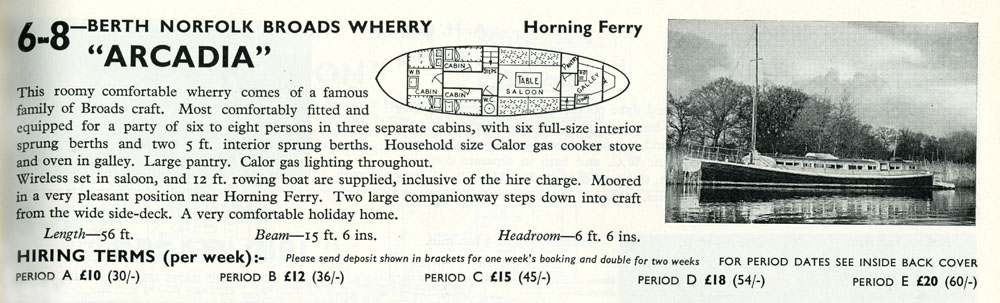
By 1956, Arcadia was lying at Horning Ferry and being let as a static houseboat through Hoseasons. Sleeping six to eight persons and boasting a household calor gas cooker and gas lighting throughout, Arcadia cost between £10 and £20 per week to hire depending on the time of year. A wireless set in the saloon and a 12ft rowing dinghy were included in the hire terms.
As an old, and presumably deteriorating wooden boat, her days were sadly numbered. It’s hard to believe now, but little historic worth was placed on such craft back then and if repair was deemed economically unviable they were discarded or destroyed. In an article written for the Norfolk Wherry Trust in 2000, Mike Barnes mentions that Windboats at Wroxham were interested in buying Arcadia in the early 1960s and converting her into a floating dancehall but were unable to secure a licence for the venture. There was a photograph of Arcadia taken at Wayford Bridge in 1963 on the Royalls boatyard blog (sadly, no longer online) and the accompanying text confirmed that she was sunk in a dyke there around this time. The Royalls are, of course, members of the same family who originally commissioned Samuel Gibbs to build Forget-me Not/Arcadia in 1897.
The survivors are few, but thankfully their historic importance is now recognised and cherished. Hopefully their future is secure but funds for ongoing maintenance is always needed. Keep an eye on the Wherry Yacht Charter Trust website for details of their public sailings during the summer which are an affordable way of stepping back in time to experience a little bit of Edwardian Broadland. I’ll leave you with a link to the short film I put together of out sailing trip with the trust on the wherry yacht Norada in 2012.


