It was the war to end all wars. The German declaration of hostilities against Russia on the 1st of August 1914 heralded the start of the First World War and the so called era of modern warfare began. By the time fighting ceased on Armistice Day in 1918, it is estimated that around 15 million people had lost their lives, with a further 20 million wounded. Around 10 million of those who died were military personnel and over 800,000 of those were British. The numbers are just staggering, and nothing could have prepared the young men who were sent off to fight for the unimaginable horrors they were to face on the battlefields of Europe.
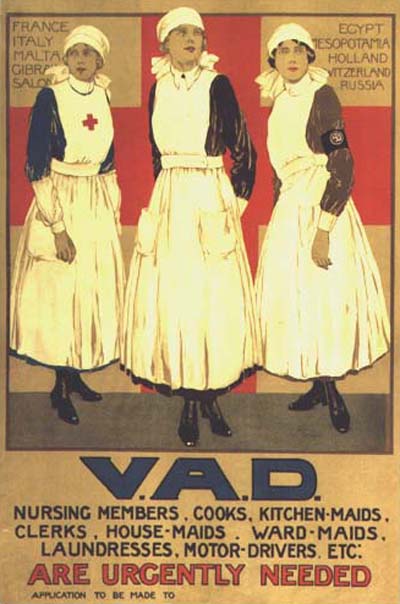
WW1 V.A.D. recruitment poster
Those who were wounded in battle were treated in field hospitals before being moved to temporary hospitals which had been set up further back from the front line. These were quickly overwhelmed by the sheer number of casualties arriving and, once able to travel, the wounded were shipped back to Blighty for further treatment and convalescence. Our military hospitals were also soon full and the desperate need for further beds saw Red Cross and V.A.D. (Voluntary Aid Detachment) auxiliary hospitals being set up in towns and villages all over Britain. Private houses and public buildings such as church halls and schools were all utilised, staffed largely by volunteers from the local area who received training in first aid and home nursing. Whilst the War Office paid a small daily allowance for the care of patients, the running costs and equipment needed was often funded by wealthy benefactors (sometimes the owners of the houses which had been turned over for use as a hospital) and by local fundraising …. even the uniforms which were worn by the volunteer nurses were usually paid for by the girls themselves.

Brundall House
There were quite a number of these auxiliary hospitals dotted around Norfolk and Suffolk including “Ingham Old Hall” near Stalham, “Sunny Hill” at Thorpe St. Andrew, a Red Cross hospital in Beccles , “St. Gregory’s” at Wroxham and “Brundall House”. I’ve had a collection of old postcards which were taken at the Brundall House V.A.D. Hospital during the First World War on my computer for a while but didn’t think that they would really fit onto the main Broadland Memories website. With Armistice Day just over a week away, I thought that I’d post a selection of them on the blog instead. They are an interesting, but also quite a sad and thought provoking set of images which capture daily life at the hospital – scenes which must have been mirrored up and down the country. Many of the patients seen would probably have been shipped straight back off to the front line once they were deemed to have suitably recovered, with no regard for the mental trauma so many must have been suffering from.
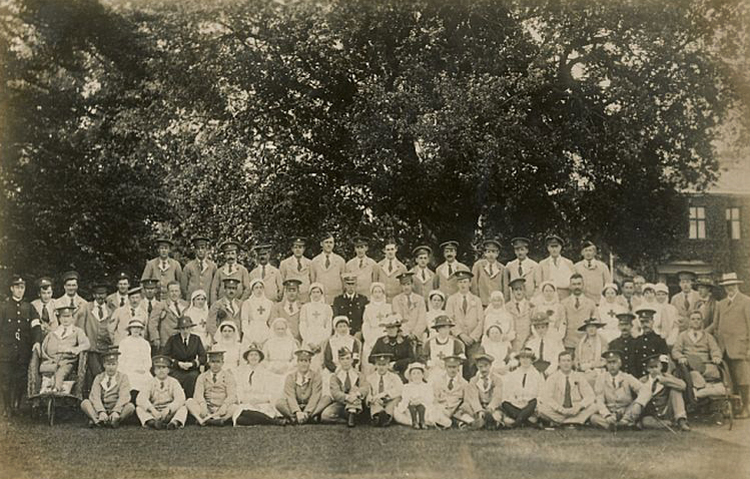
Patients and staff at Brundall House VAD Auxiliary Hospital c1915
There is a little bit of information about the hospital in “The Book of Brundall & Braydeston: A Tale of Two Norfolk Parishes” which was produced by the Brundall Local History Group and published by Halsgrove in 2007 (ISBN 978-1-84114-630-0), plus more photographs and information on their website. The imposing “Brundall House” was owned by a Mr Ffiske and stood within sizeable grounds overlooking the River Yare, a site now occupied by Finch Way. Between 1914 and 1916 the hospital apparently cared for over 700 patients including around 300 Canadian servicemen – this was in common with many of the auxiliary hospitals who received casualties from the various nationalities which made up the allied forces. Whilst the main military hospitals cared for the more seriously wounded, the V.A.D. hospitals played a vitally important role in the care and rehabilitation of those with lesser injuries. It’s evident from the photos I have, and from those on the Brundall Archive website, that it would certainly have been a less formal environment in which to recuperate, and regular outings and activities such as boat trips, sports days, concerts and stage plays were all photographed. The patients were issued with blue flannel suits and red ties – according to the Brundall & Braydeston book, this was to make them easily identifiable and deter them from visiting the local pubs which were out of bounds!
I can’t tell you a great deal more about the images, or who features in them, but they stand as a very poignant record of the human tragedy of the Great War and the tireless work performed by the Red Cross and the V.A.D.’s throughout those difficult years.
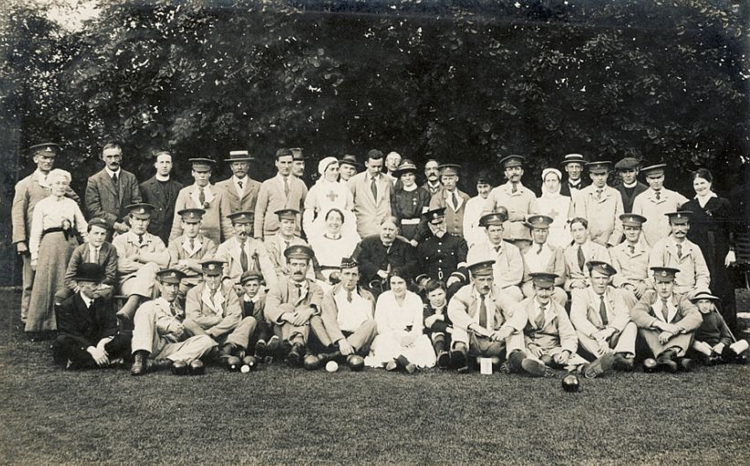 Patients and staff who have, presumably, been involved in a bowls match!
 Patients and staff at Brundall House hospital c1915
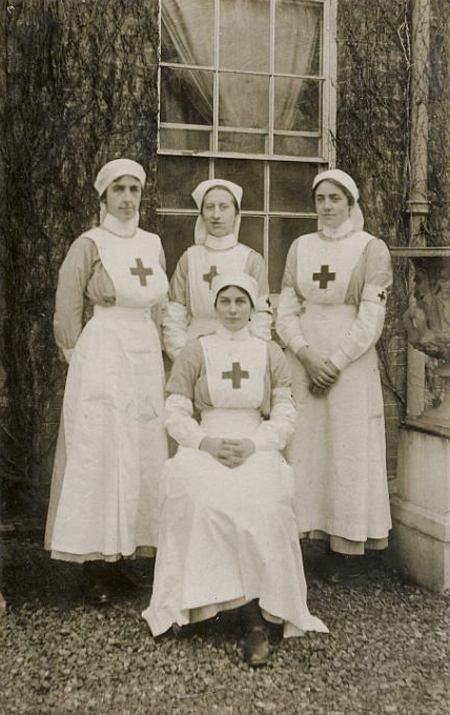 Nurses at Brundall House Hospital c1915
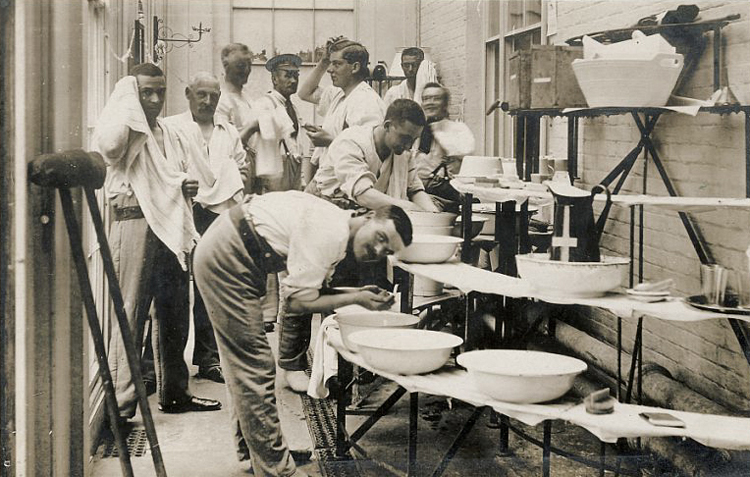 The washroom at Brundall House c1915
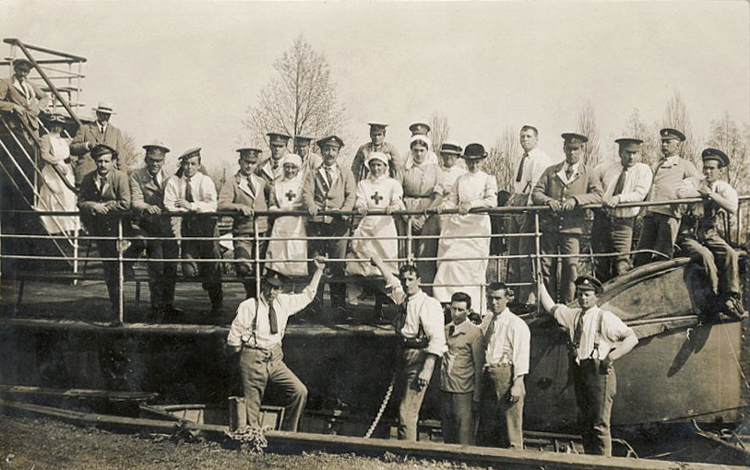 An outing on what appears to be a large passenger steamship
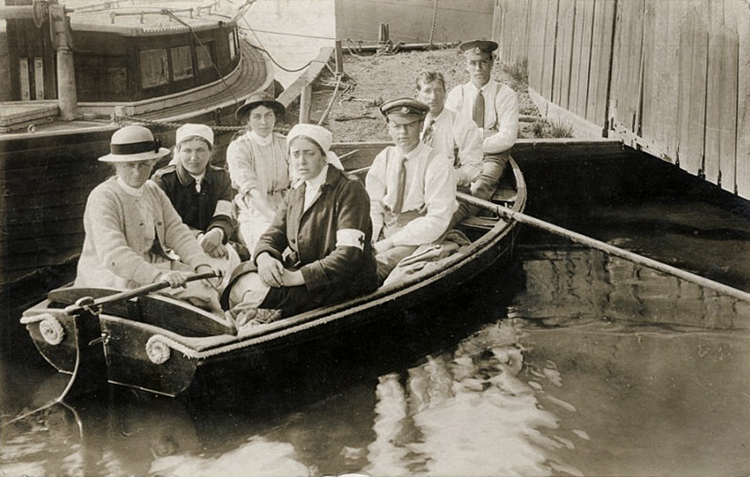 Messing about on the river!
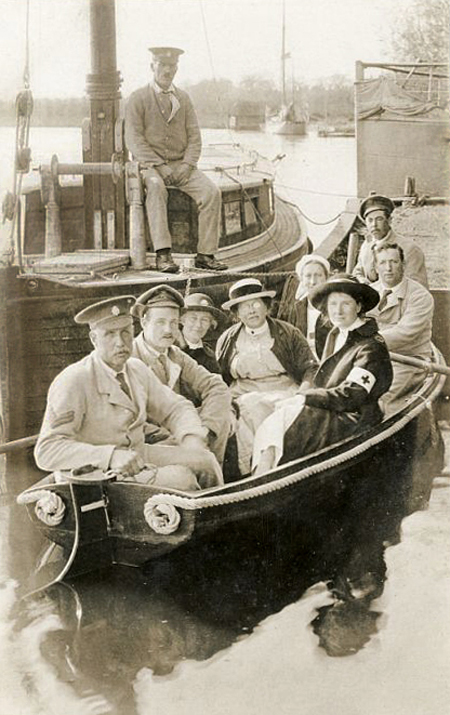 Presumably taken on the same day as the previous photograph
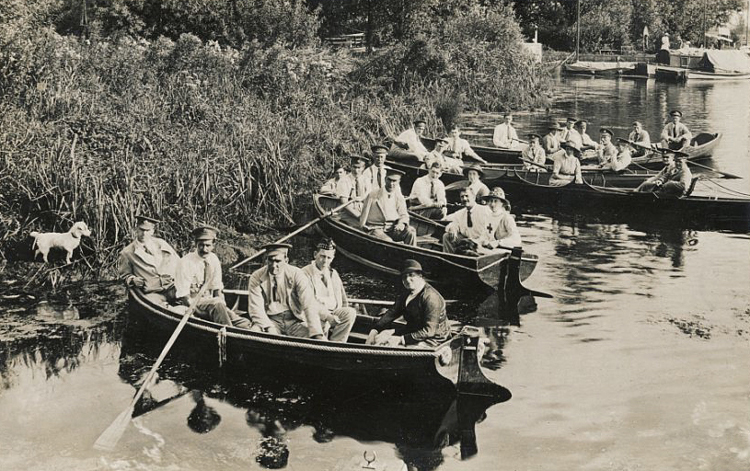 Another photograph of the patients out on the River Yare c1915
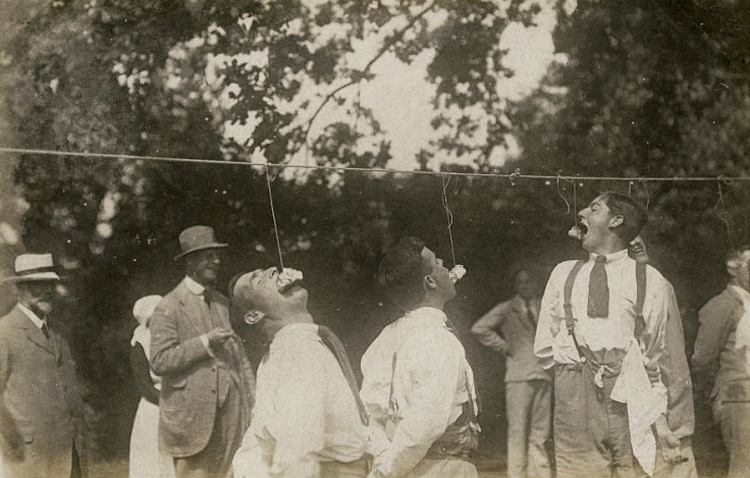 I’m not quite sure what the competitors in this sporting event are trying to eat!
 The final photo shows what would be deemed a very non politically correct activitiy today, but dressing up as black minstrals seems to have been quite popular entertainment at this time and, indeed, continued well into the 1970s on British TV!


