
Designed & maintained by Carol Gingell

© C.Gingell 2006-
© Broadland Memories 2006-


 Pre 1900 History
Pre 1900 Memories
Pre 1900 History
Pre 1900 Memories
Pre 1900 Photo Gallery

Amongst the collection of what were mainly landscape photographs and family group shots was a single, interior portrait of this gentleman. He appears (rather furtively) in only one of the Broads photographs which makes me wonder whether this was our mystery photographer. It is such an informal pose for the era -
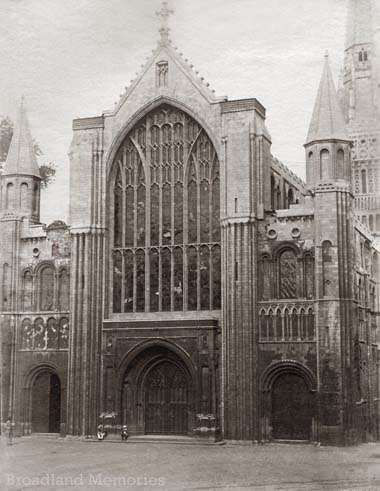
The photographs predominantly feature the southern rivers, most were given captions. This is the West front of Norwich Cathedral, the large window and ornate entrance porch being 15th century alterations to the original building. Ernest Suffling wrote that Norwich; “in point of quaintness and antiquity, will vie with any English city.”
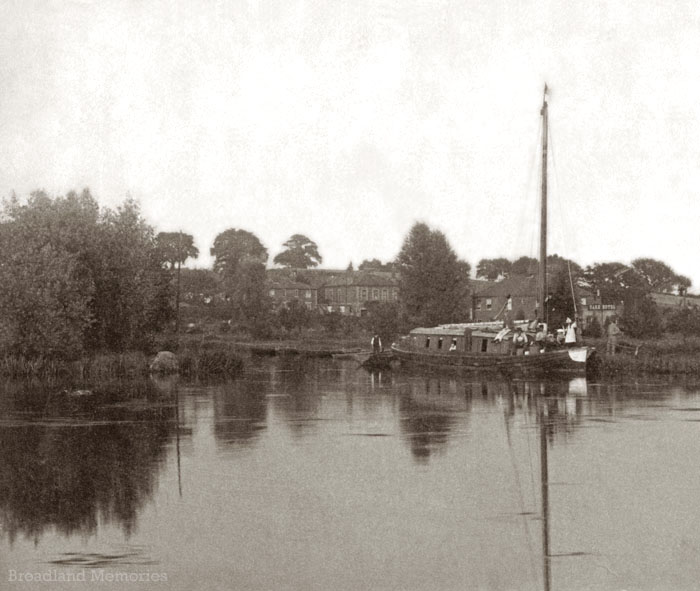

Oulton Broad, with Mutford Lock in the centre of the photograph. The original Wherry Inn is to the left of centre, obscured from view here by a large tree. In ‘Land of The Broads’, first published in 1885, Ernest Suffling wrote; “Boats, bait and light refreshments, or substantial meals, may be obtained at the Wherry Inn, adjoining the Broad, and close to the station. The bar-

Captioned as being “On the River Waveney”, this photograph shows the group on board Phoenix and the wherry Eagle once again. In Charles Geard’s account of the Seine trip aboard Phoenix, he provided a good description of the vessel:
“She is 70 feet long and 11 feet wide, and has a saloon which will comfortably dine nine passengers, and near which is a galley or kitchen more commodious, I am told, than on many a thousand-
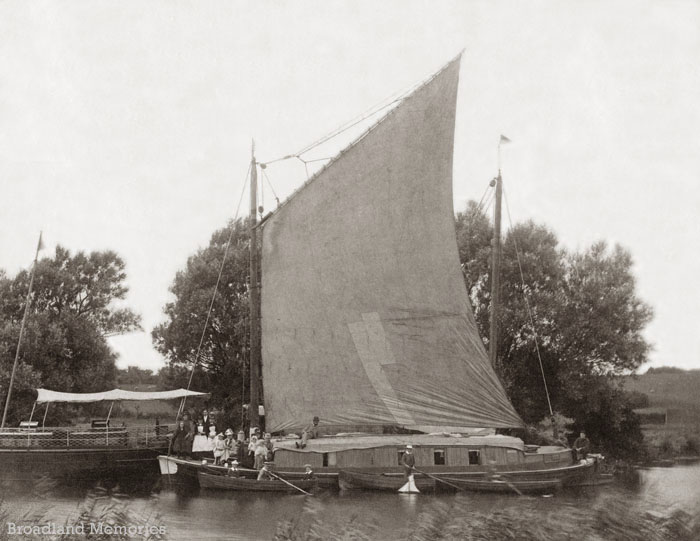
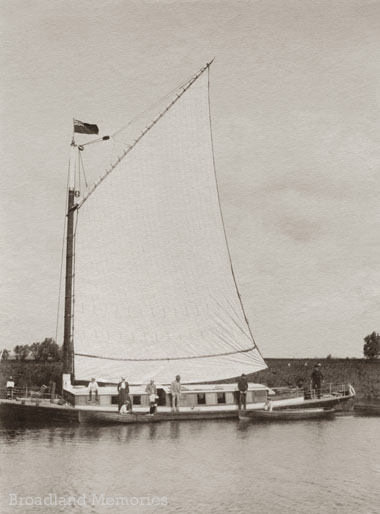
Captioned as “The Wherry Eagle” this shows her in the company of Phoenix once again, with the holiday group on board. She looks to be quite a rough and ready conversion to me in this photograph, with patchy sail and tarpaulin thrown over the roof. Would she have been a temporary summer conversion perhaps, reverting back to carrying non human cargo during the winter months. Note the model yacht in the water.
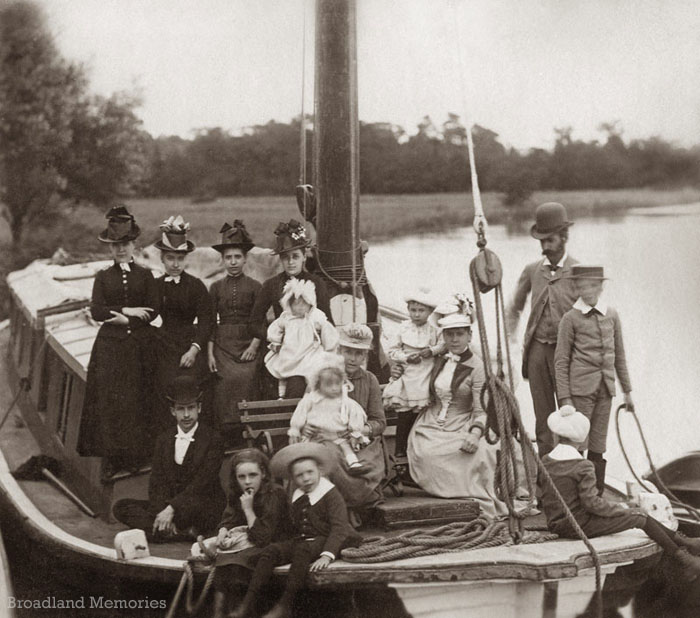
The holiday party pose on the foredeck of The Eagle -
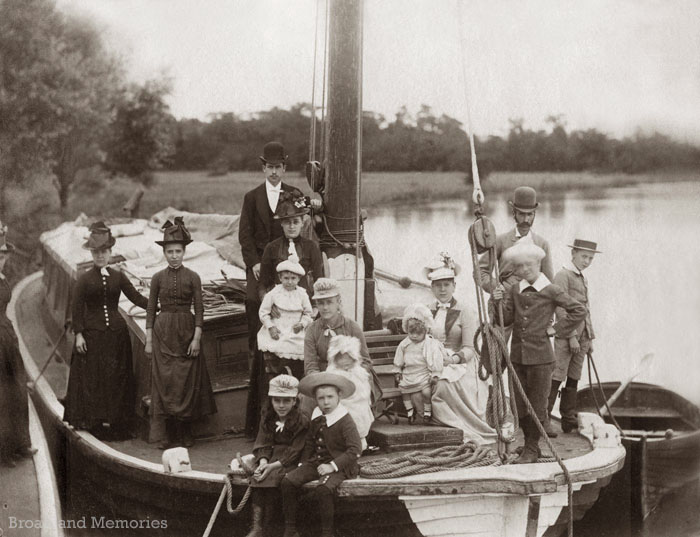
A second version of the group shot on board the wherry Eagle. The clothing and the hats are wonderful. On the subject of suitable boating attire for the era, Ernest Suffling wrote; "For ladies dress (I will say little here, or I shall get out of my latitude), nothing can compare with navy serge made up in a very plain manner, so as to prevent few folds as possible for boughs of trees, oars, etc., to catch in. A little bright colour in the trimming, if you please, ladies! and be sure and wear strong watertight boots in place of dainty, fancy French shoes." The usual suggested boating attire for gentlemen included flannel trousers, shirts, a blazer and cap or straw boater, rubber soled tennis shoes, two pairs of socks and a change of underwear.

The Bell Tower at Beccles, viewed from New Market, with the White Swan public house seen on the right. The pub bears the name of the Morse and Woods Brewery. Frederick Morse formed the Crown Brewery at Lowestoft in 1842 and went into partnership with Henry Woods in 1844. The Morse family also had breweries in Swaffham and Norwich.The Crown Brewery was bought by the Norwich brewer Morgans in 1936.
This was the pleasure wherry Gladys, pictured at an unknown location in the 1880s with the family group, plus skipper at mate on board. Gladys was listed as being a converted trading wherry in Roy Clark’s ‘Black Sailed Traders’ and she is unusual in having a rather nice counter-
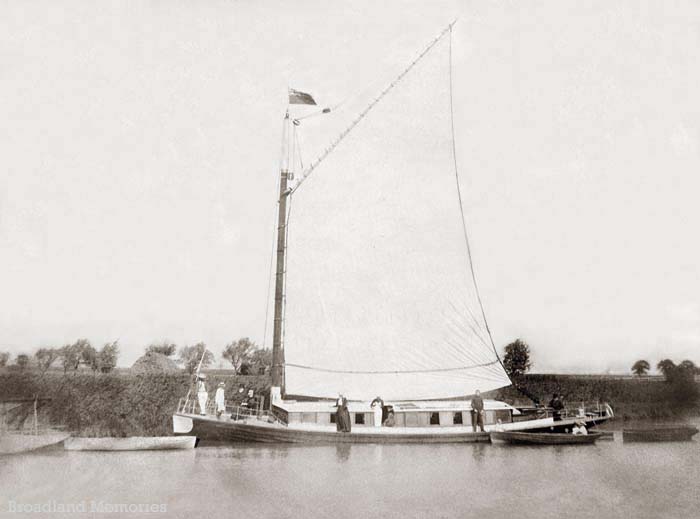
A second photograph of Gladys taken at the same location as the previous photograph. Note that the sail has it’s ‘bonnet’ laced along the bottom, designed to increase the sail area in lighter winds. Gladys appears to be a bit of an unknown, and these may be the first photographs of her to have been found.
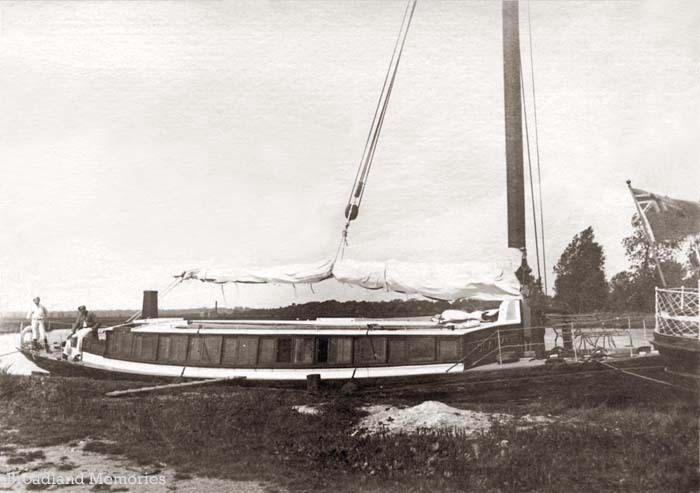
Another photograph of Gladys which, I suspect, may have been taken somewhere on the River Waveney, To the right, you can just see the stern of the steam vessel Phoenix which was pictured in the company of The Eagle in earlier photos in this set. This is another interesting photograph which shows a portable chimney in use above the crew’s cuddy where the stove would have been situated. Roy Clark provided the following description in ‘Black Sailed Traders’; “The stove is against the bulkhead facing the doors. It has a small oven and will roast meat or bake pies. On top it will fry steak, chops or bacon and boil vegetables. It burns coal, and is polished to such brilliance with black lead, that you can almost see to part your hair in it.” The metal flue from the stove came out through the cabin roof, faired by what was known as a coburg, made of wood and designed to stop the main sheet catching light. The square, wooden chimney was placed over the top when moored and was stowed away when under sail.

Potter Heigham Bridge with George Applegate’s boatyard just out of shot on the left. The steamer Phoenix can just be seen on the right, moored in front of the old Bridge Hotel. This is another very interesting image as the name above the hotel is The Waterman’s Arms, which was the name of the original pub which stood here. Examining the photograph more closely, I realised that the original pub was still in situ, behind the new building and you can read “Waterman’s Arms, Bullards Ales” on the gable end. Most literary sources put a build date for the hotel at around 1900 but this photograph certainly pushes that back further. Research in contemporary trade directories, guide books and census returns indicate that a build date of around 1887 to 1889 seems likely. I covered that research in an article for the Broadland Memories blog entitled The Waterman’s Arms.
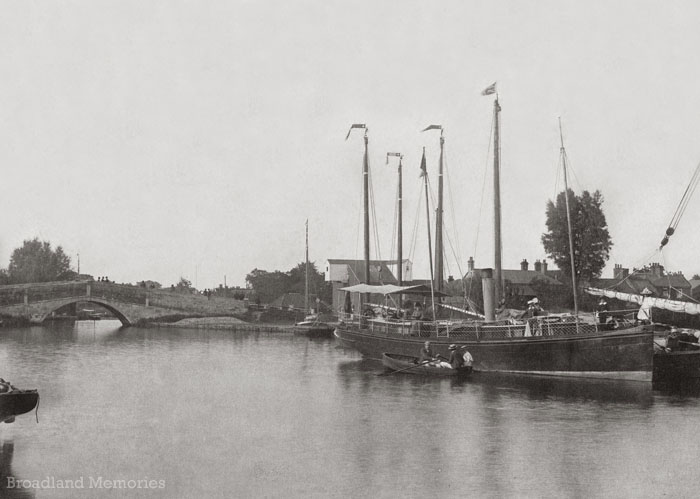
Phoenix moored downstream of Wroxham Bridge, a photograph which shows how little Hoveton and Wroxham had been developed at this time. John Loynes boatyard had been established on the opposite side of the River in the mid 1880s but both the Horseshoes public house and the King’s Head were hiring out boats at this time. The presence of a railway station within easy reach of the main London to Norwich line meant it was an obvious starting point for boating holidays.
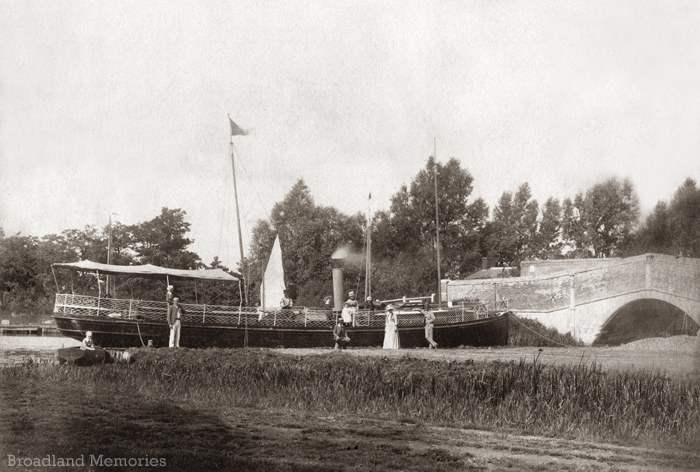
Another view of Phoenix at Wroxham Bridge. In ‘Best Cruise on the Broads’, John Bickerdyke had this to say about the village in the 1890s; “Wroxham Station is a little shanty which will be swept away some day by one of those blizzards which we import from the States, but it answers its purpose fairly well.” He mentioned both The Horseshoes and the King’s Head Inn; “the last mentioned being the more pretentious hostelry of the two … for when one of my party tumbled overboard, there was no drying his clothes at the King’s Head, while at the more humble establishment every assistance was given us.” It was quite a well served village, however, where one could send and receive post and telegraph messages whilst on holiday, there was a grocers and a butcher where you could buy mutton and beef, and a bakehouse at the foot of the bridge which also sold tobacco and beer.
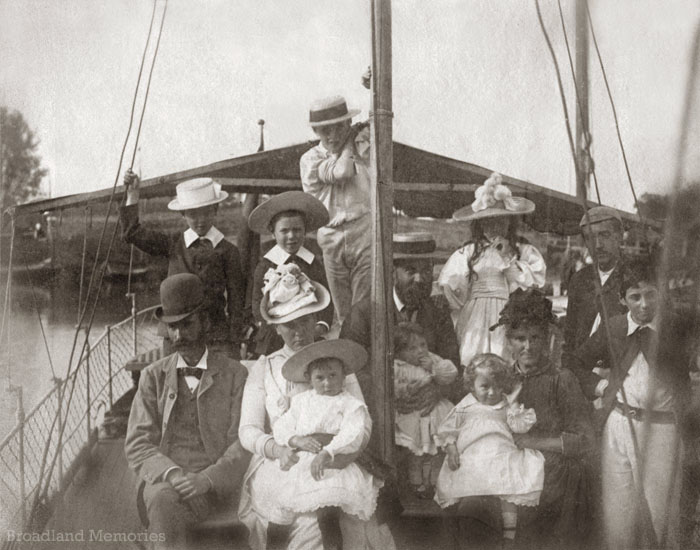
The final photograph from this collection shows the family group aboard Phoenix. The gentleman in the centre is the mystery gentleman whose portrait began this set. This is the only image in which he is seen, which is why I believe that he may well have been our photographer. I think this must also have been taken at Wroxham, with Loynes boat sheds in the background. You can read more about boating on the Norfolk Broads during this era in the Broadland Memories blog post A very Victorian Cruise on the Norfolk Broads.

The view looking upsteam on the River Waveney from Beccles Bell Tower. You can see the rail bridge in the centre of the photo with the old road bridge beyond. The road on the bottom right is Smallgate. “The sail up to Beccles is a very pleasant one, and pretty bits continually present themselves” wrote George Christopher Davies. “Beccles is a quiet, old fashioned place, with good railway accommodation, as a glance at the map will show.”
The following collection were bought as a series of three lots of loose pages which had been split form an original Victorian album. The pages contained twenty images of the Norfolk Broads, along with a few taken on the Belgian and Dutch Canals and couple of photos of London. I know nothing of the origin of these photos, but they were clearly taken by someone who was part of a very well to do, well travelled family. The collection also contained a photograph of the 1885 menu for the Norwich Angling Club annual dinner which gave me a starting point in trying to date these. Using what clues could be found with the photos, I trawled contemporary guide books, trade directories and census returns and spent hours researching the subtle changes in ladies and men’s fashions over the latter decades of the 19th century. It appears that these would date from between 1885 and 1889 and were probably taken over the course of more than one trip. The party consists of what look like an extended family group and the photographs feature the family aboard two wherries and a large steam vessel named Phoenix.
This was the wherry Eagle, photographed at Brundall with the Yare Hotel seen in the background. The Eagle appears to be a converted trading wherry, although I can find no mention of a wherry of this name. William White’s 1883 ‘History, Gazetteer & Directory of Norfolk’ lists the owner of the Yare Hotel as being H. Flowers who was also listed as boat, fishing tackle and refreshment proprietor at Brundall Fishing Station. White wrote; “The Yare Yachting, Boating and Angling Station belongs to Messrs. H. Flowers and Co., And comprises about 13 acres of land, situated in sight of Surlingham Broad, and within easy sail of the Rockland and Strumpshaw Broads.” Brundall was a small village at this time and there were just 54 inhabitants recorded on the 1881 census. The dyke seen here is now owned by the Broom Marine Group, a boatyard which had humble beginnings when C.J. Broom first established his boat building business here in 1898.
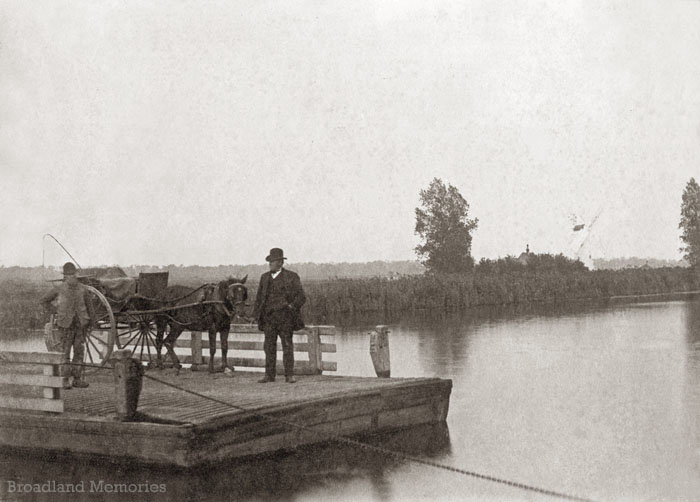
This wonderful photograph shows Buckenham Ferry in operation on the River Yare -
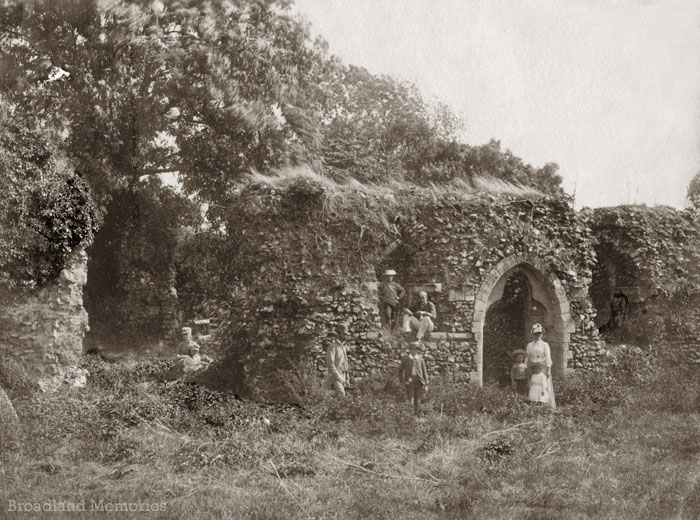
Captioned as Langley Abbey, this shows the holiday party posing on the rather overgrown ruins. The abbey was founded in 1195 by then then Lord of Langley, Sir Robert Fitzroger, as a Premonstratensian monastery and was run by white-
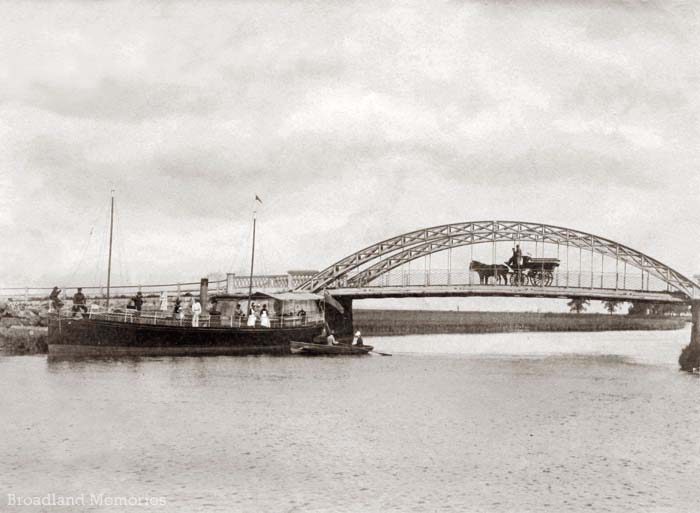
This was the large steam vessel Phoenix which accompanied the holiday party on board the wherry Eagle, pictured here at St Olaves Bridge. The photographer must have asked the driver of the horse and cart to position himself there for this picture. I was contacted by David Asprey from the Caledonian Maritime Trust who has provided the following information about Phoenix. This iron hulled steam yacht was built and engineered in 1870 by the Plymouth Foundry and Engine Works Ltd, in Devon. The company apparently went in to liquidation later that year, so this may have been the last vessel they built. Her first owner was J.Michael & Co., of London and Bordeaux, under the name Arachon. She was used in service between Bordeaux and Arachon, presumably under a French flag. In August 1886, the name was changed to Phoenix under the ownership of John David Mason of West Norwood, South London. By 1887, Phoenix was being advertised as “Portable Lodgings” by Charles Geard, also of London. It had three, double cabins and could take 51 deck passengers. In 1892, Geard wrote an account of a taking Phoenix on a cruise on the Seine in France which was published by Pall Mall magazine. In it, he mentions that Oulton Broad was her usual winter mooring spot and where she was then fitted out for her summer trips. Perhaps these photographs feature Charles himself, or members of the Geard family? In 1908, British registration for the vessel closed.
From the bridge, the party could have walked to the nearby Fritton Decoy, a popular attraction written about in several guide books of the era, where vast numbers of wild duck were caught by luring them into long, netted tunnels, using tame ducks as decoys. In the ‘Handbook to the Rivers and Broads of Norfolk and Suffolk’, first published in 1882, George Christopher Davies described the bridge as being “a rather handsome structure. There are a few houses grouped rather prettily, and a good inn, The ‘Bell’ close by the Bridge.”