I always tick the “none” box on forms when asked about religion, but confess that I do find churches quite fascinating. It’s not unusual to find me mooching around churchyards, studying the memorials and headstones of the long since departed, and I’ve come to the conclusion that the people of Broadland were often a hardy and long lived bunch! The church of St Mary the Virgin which overlooks the River Waveney at Burgh St Peter is probably my favourite of all the Broadland churches and a visit to the nearby Waveney River Centre is never complete without a stroll along the lane to have another look. I invariably spot something which I haven’t noticed before.
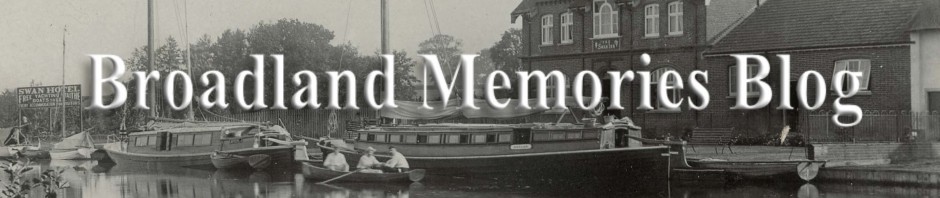
 100 years ago, the church was a prominent feature in the landscape when viewed from the river. Over the years, the trees have grown up around it and it has become largely obscured, except for a tantalizing glimpse of the tower as you approach the Waveney River Centre. The photograph on the left dates to c1912 and shows the view looking across the river to what is now the WRC, with St Mary’s clearly seen in the background. It’s certainly not a view which could be recreated very easily today as pretty much all you see now are trees, but it’s fantastic illustration of just how the much the landscape of the Broads has changed over the last century. The picturesque, tree lined stretches of waterway which are now so quintessential of the Norfolk and Suffolk Broads were considered to be a hindrance by the wherrymen of old. Every drop of wind was precious and anything which prevented it reaching their sail would be looked upon with disdain. As such, the riverbanks were kept clear of trees and scrub where possible, often by the hands of the wherrymen themselves who would haul out new tree saplings as they sprang up. As the wherry trade declined, nature inevitably took over.
 It’s thought that a church would have stood on this site in Saxon times but the origins of the current building lie in the middle ages, with parts believed to date back to the 13th century. As with most ancient churches, St Mary’s has been extended, rebuilt and restored many times over the centuries, but it’s the late 18th century, ziggurat tower which really gives the church its character. Like the layers of a wedding cake, it rises majestically from the flint remains of the original, 16th century tower and was commissioned and paid for in 1795 by Samuel Boycott, then rector of St Mary’s. The design is believed to have been inspired by buildings seen in Mesopotamia by his son William whilst on the grand tour. The bottom, flint layer (the original vestry) was enclosed and became the Boycott family tomb, a new vestry being created on the floor above, accessed by a narrow staircase. An early drawing shows that there was originally a finial on top, the remains of which now lie at the base of the tower.
 I was pleasantly surprised to find that the door was unlocked, so couldn’t resist going inside to have a look. Stepping in through the robust, 13th century wooden door, I was greeted by that heavy, musty aroma which so often seems to pervade such places. Having walked round the outside of the church first, it was noticeable just how much lower the floor is compared to the surrounding ground. The building was restored following a fire in 1996 which saw most of the roof destroyed. Looking at the roof timbers now, you would never know.
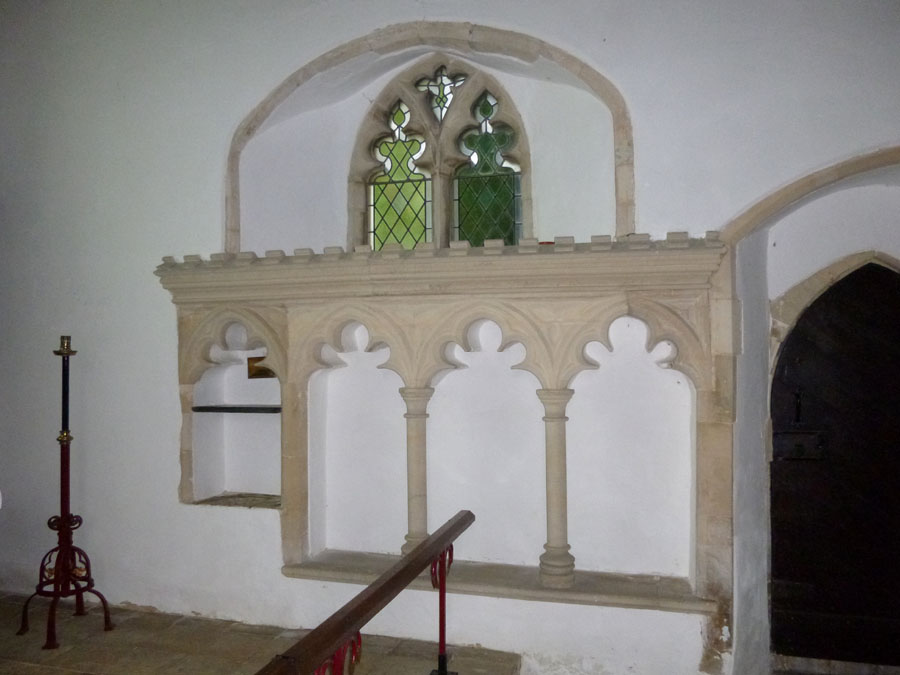 The interior has lots of interesting features, but I loved this one. This range of three seats, known as a Sedilla, were intended for the use of officiating clergy and date from the 14th century. Comfort obviously didn’t feature too highly on the list of requirements for priests in the 1500s. To the left of the seats, housed in the small arch, is what appeared to be a sink. This was apparently used for washing communion vessels after use. The village priest would have have said mass daily in the church and held several services on a Sunday along with presiding over weddings, funerals and baptisms. He would also have been responsible for educating his parishioners in basic religious doctrine and practices, doing his best to ensure that his flock didn’t stray from the moral path!
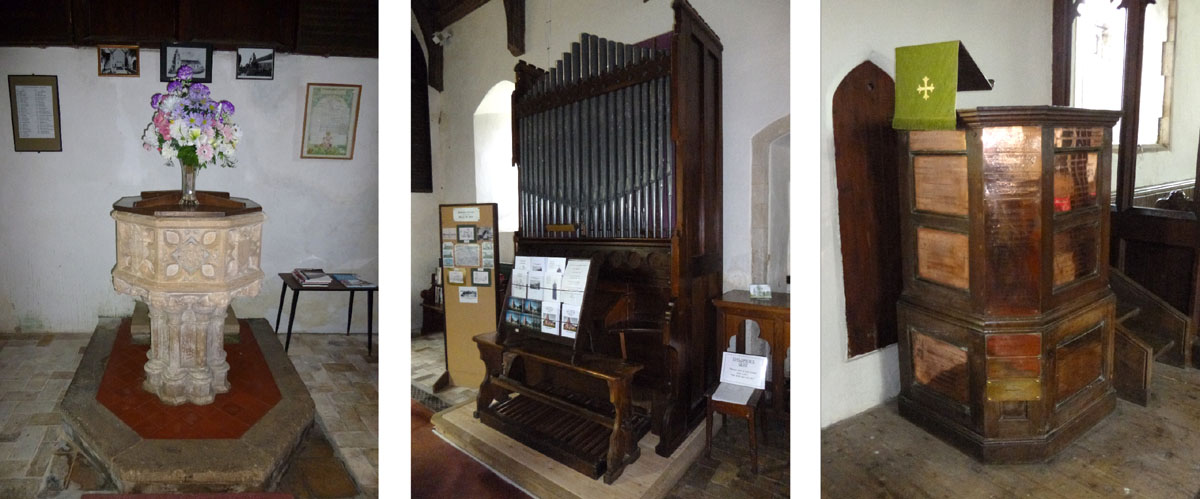 The ornate, carved stone font is thought to date from the 14th or early 15th century. Holy water would be blessed at Easter and remain in the lead lined font for use over the following year, covered by a lockable lid to prevent it’s theft. As a keyboard player in local bands in a former life, I loved the pipe organ which came to St Mary’s in 1896 from the church of St James in Great Yarmouth. On the right is the pulpit, installed by the Boycott family in the early 1800s. The plaques all bear memorial inscriptions for family members. Between 1764 and 1899, five successive generations of the family became rectors at Burgh St Peter, but it was Charles Cunningham Boycott, son of the third rector, who was responsible for the family name entering the English language as the verb following a notorious incident in Ireland in 1880.
Born at Burgh St Peter in 1832, Charles was the second son of rector William Boycott. He began a military career with the British Army 39th Regiment of Foot which took him to Ireland. It turned out to be a short lived career, impeded by illness which led him retire to begin farming land in County Mayo with his new wife Annie. He became a land agent for the Earl of Erne at a time when a campaign, led by the Irish Land League, seeking reforms to the land laws and protection for the rights of tenant farmers was gathering momentum. There were calls for rents to be dropped to assist farming families who were still suffering the knock on effects of the potato famine of the 1840s. Charles Stewart Parnell, president of the Irish Land League, urged peasant farmers, labourers and local trades people to ostracise landowners and their agents should they attempt to evict struggling tenants. When Boycott served eviction notices on eleven tenants on the Earle of Erne’s estate, the campaign became squarely focused on his doorstep. Crops went unharvested in the fields, local shops and other businesses refused to trade with him. The peasants were literally revolting. Boycott wrote of his plight in a letter to the Times on the 14th of October 1880:
“Sir, The following detail may be interesting to your readers as exemplifying the power of the Land League. On the 22nd September a process-server, escorted by a police force of seventeen men, retreated to my house for protection, followed by a howling mob of people, who yelled and hooted at the members of my family. On the ensuing day, September 23rd, the people collected in crowds upon my farm, and some hundred or so came up to my house and ordered off, under threats of ulterior consequences, all my farm labourers, workmen, and stablemen, commanding them never to work for me again. My herd has been frightened by them into giving up his employment, though he has refused to give up the house he held from me as part of his emolument. Another herd on an off farm has also been compelled to resign his situation. My blacksmith has received a letter threatening him with murder if he does any more work for me, and my laundress has also been ordered to give up my washing. A little boy, twelve years of age, who carried my post-bag to and from the neighbouring town of Ballinrobe, was struck and threatened on 27th September, and ordered to desist from his work; since which time I have sent my little nephew for my letters and even he, on 2nd October, was stopped on the road and threatened if he continued to act as my messenger. The shopkeepers have been warned to stop all supplies to my house, and I have just received a message from the post mistress to say that the telegraph messenger was stopped and threatened on the road when bringing out a message to me and that she does not think it safe to send any telegrams which may come for me in the future for fear they should be abstracted and the messenger injured. My farm is public property; the people wander over it with impunity. My crops are trampled upon, carried away in quantities, and destroyed wholesale. The locks on my gates are smashed, the gates thrown open, the walls thrown down, and the stock driven out on the roads. I can get no workmen to do anything, and my ruin is openly avowed as the object of the Land League unless I throw up everything and leave the country. I say nothing about the danger to my own life, which is apparent to anybody who knows the country.“
Harvesters were eventually drafted in from outside the county, protected by 1000 men from the Royal Irish Constabulary. The cost to the government was estimated at around £10,000 which far exceeded the value of the crops. Charles Boycott fled his Irish home in November 1880, escorted by members of the 19th Hussars for his own safety. The use of the verb “to boycott” had quickly been coined to describe the refusal to buy or provide goods and services as a means of protest. Returning to England in December, he set up home for himself and his family in the Suffolk village of Flixton where he became a land agent for the local estate owner, and former Member of Parliament for Ipswich, Hugh Adair. He died, aged 65, in 1897 and was buried in the churchyard at Burgh St Peter, his grave marked by a white cross which stands close to the entrance porch of the church.
 It is outside the church, that you’ll discover what I found to be the some of the most interesting echoes of the church’s history. Beside the priests entrance door on the south side of the church is a sundial which has been scratched into the stonework. A wooden peg in the central hole would have cast a shadow as the sun moved through the sky, the scratches indicating the times when mass would be held during the day. I’m not certain, but imagine that this must date back to the late medieval period.
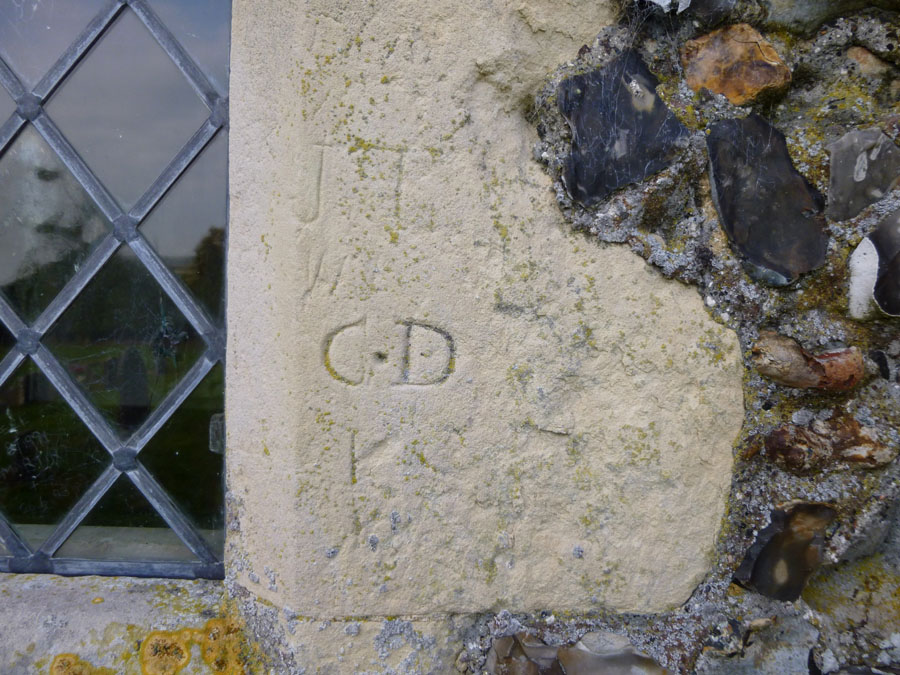 Elsewhere, there are more carvings in the stonework, historic graffiti in the form of initials.
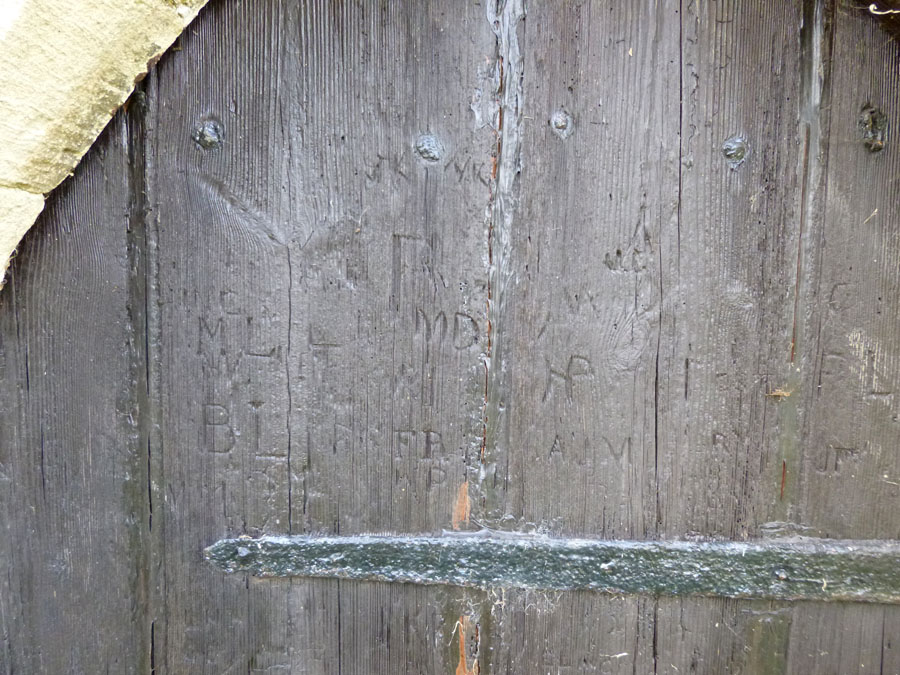 Yest more initials scratched into the priests door.
 The glass in the windows hasn’t escaped unscathed either. The graffiti here has been added over the last century or so with fairly recent examples sitting alongside those of Victorian visitors, and others from every decade inbetween. Who was HJP of Balham I wonder, and what brought him to Burgh St Peter in August 1886? An early Norfolk Broads holiday boater perhaps?
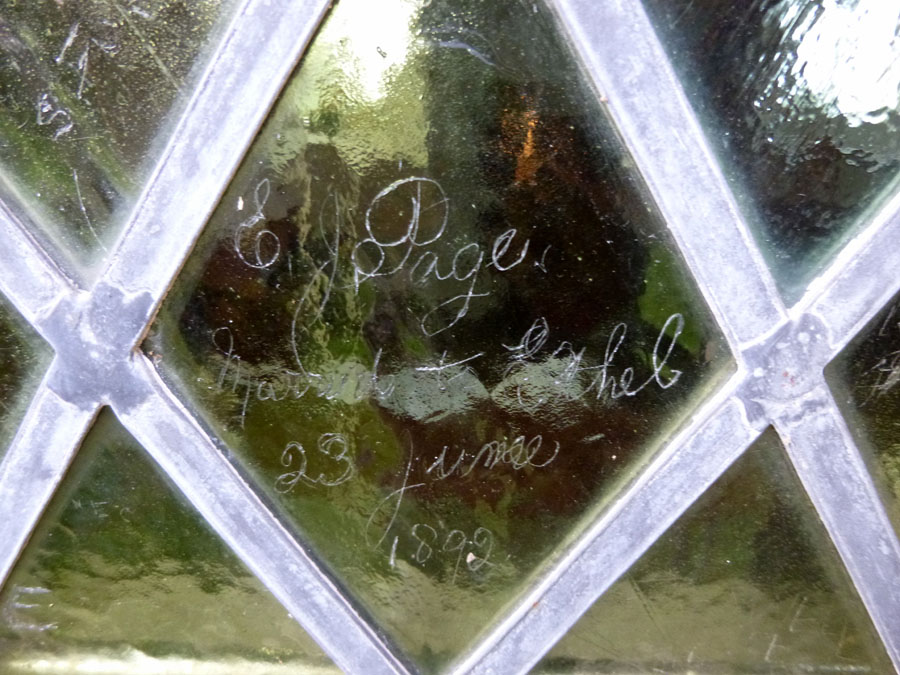 I’m sure that a quick look in the parish registers would tell us who the E.J Page who married Ethel here on the 23rd June 1892 was. This was probably my favourite inscription. I wonder if they had a long and happy life together and whether there are descendants still living in the area. It has to be said, Victorian vandals had far better handwriting standards where graffiti was concerned.
A final word of caution though – beware if you visit St Mary’s on the night of the 2nd of May. Legend tells how the founder of the original church sold his soul to the devil in return for vast riches, some of which he used to build a chapel on this spot. When he died he was buried within the church. Disguised as an old man, the devil now waits for his resurrection in the porch, unable to enter its sacred walls. Look closely, and beneath the old man’s cloak you will catch a glimpse of a skeleton, spitting fire and brimstone from within, it’s long, bony fingers clutching the parchment upon which Adam Morland signed his soul away.


